Figurative Paintings of Women in Water: Symbolism, Emotion, and Expression
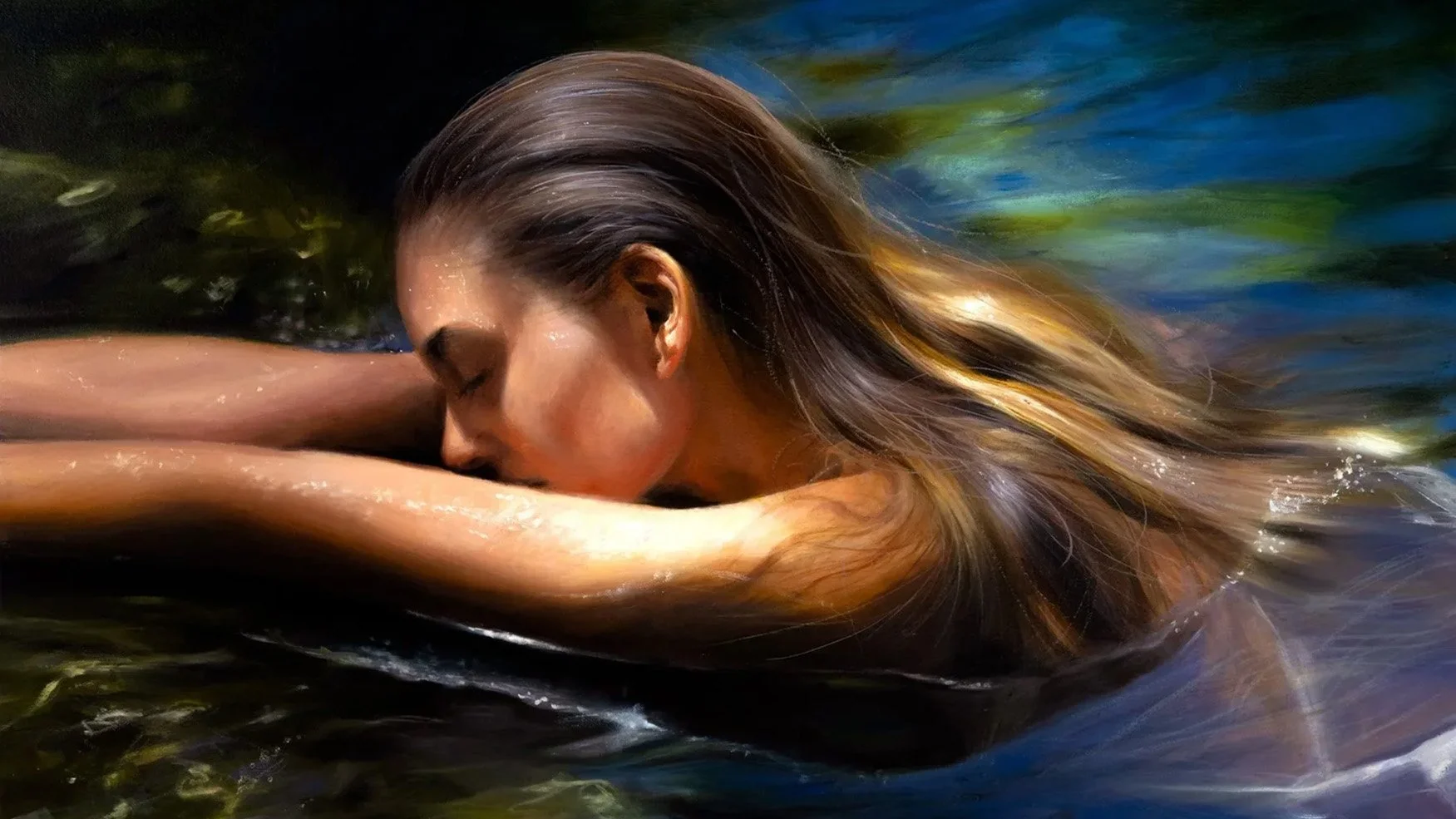
Water resists simple interpretation in visual art. It alters the body’s relationship to gravity, distorts form through refraction, and transforms familiar gestures into something less fixed and more provisional. In figurative paintings of women in water, the medium operates as an active presence rather than a passive setting, shaping how the figure is perceived and how meaning emerges.
Underwater, the body appears less defined. Light fractures across the surface, breaking into shifting patterns that soften edges and blur boundaries. Limbs elongate or compress depending on depth and angle. Hair moves independently, guided by currents rather than intention. The figure exists in a state of visual instability, never fully settling into a single form.
Historically, water has carried dense symbolic associations, including birth, purification, danger, and renewal. These associations remain available, but they do not dominate the work. Symbolic resonance exists alongside physical specificity. The pressure of water, the altered palette of submerged light, and the slowed movement of the body register as lived conditions rather than abstract ideas. Meaning arises through observation rather than declaration.
Viewers often bring personal experience to these images. Swimming, immersion, breath, and memory shape how the paintings are read. For some, the water suggests calm or sanctuary. For others, it introduces a sense of suspension or isolation. The work allows for multiple readings without resolving them, offering space for projection while maintaining visual restraint.
The relationship between figure and environment plays a central role. Traditional figurative painting often relies on clear separation between body and ground, but underwater that distinction collapses. Skin absorbs surrounding color. Shadows deepen unpredictably. Light behaves less like illumination and more like movement. The figure becomes embedded within a larger visual field rather than isolated from it.
In some paintings, the submerged figure approaches landscape as much as portraiture. The body provides scale and motion within a broader investigation of water itself, its density, reflectivity, and capacity to hold light. In others, the emphasis shifts toward interiority, with stillness and suspension suggesting psychological states without naming them.
What unites these works is a refusal to fix meaning too tightly. The women in water are neither purely symbolic nor purely descriptive. They occupy a space between presence and dissolution, clarity and obscurity. The paintings remain open, allowing formal decisions such as light, color, distortion, and depth to carry emotional weight without prescribing interpretation.